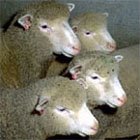
So-called pharm animals are being described as "revolutionising" the pharmaceutical industry.
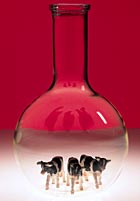
Pharming refers to the use of host animals (and also plants) to express certain qualities (for example, in their milk). Such animals have been described as "animal factories," and their use has attracted a great deal of criticism and debate. As well as concerns over safety (such as the Starlink controversy and the ProdiGene episode), such use of animals has raised ethical questions from various groups, including Animal Liberation (Australia) and the British Union for the Abolition of Vivisection (BUAV).
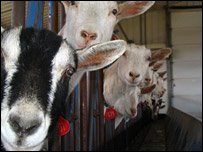
One such pharm animal is on its way to market. European regulators have recently approved a drug produced in the milk of genetically modified goats.
ATryn is a recombinant form of human antithrombin (ATIII), used in the treatment of hereditary antithrombin deficiency (HAD), where the individual is missing the gene responsible for making the protein, antithrombin. HAD can lead to various problems, including deep-vein thrombosis, because the blood clots too easily. ATryn is lauded as much safer to deliver the missing copy of the gene than other methods, such as through human blood plasma (which carries the risk of vCJD). Antithrombin is administered to HAD patients during times when the usual treatment by warfarin is too risky (such as during childbirth and surgery).
GTC Biotherapeutics, the company responsible for developing the drug, applied for European Market Authorization in January 2004, as discussed in an earlier post, Milking Medicines. However, in February this year, (see previous post, Crying over Spilt Milk), the European Medicines Agency (EMEA) refused the application to license ATryn, calling for more evidence on the benefits of the drug. After reversing this decision and deciding to issue the licence in June, as set out in its positiv
 e opinion, the EMEA Committee for Medicinal Products for Human Use (CMPH) has now given approval to the drug (as reported in The Times and a GTC press release).
Tom Newberry, spokesperson for GTC Biotherapeutics, claims the drug could be available in the UK and Europe from mid-2007. The company also has many more transgenic products in various stages of development.
The European approval of the transgenic drug is a boost to other drugs being developed, including the production of polyclonal antibodies in chicken eggs for the treatment of cancer (Origen Therapeutics); the production of high level proteins in insect larvae (Minos Biosystems); and several treatments being developed by Pharming and produced in the milk of transgenic animals. Pharming recently announced its application to the EMEA for marketing authorisation of Rhucin, a drug to be used in the treatment of hereditary angioedema, accepted for review by the EMEA. If approved, Rhucin will receive marketing authorisation in all 25 EU member states.