The Dominican Republic is considering an extension to patent protection in order to give effect to its free trade agreement with the US.
The DR-CAFTA was agreed back in December 2003 after only 12 months of negotiation involving the US, El Salvador, Guatemala, Honduras, Nicaragua, and Costa Rica. Costa
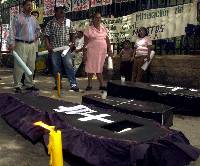
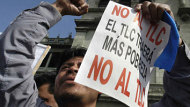
 Rica remained resilient in the negotiations until January 2004, generating ongoing oppositions that continue today. Just 10 days ago, Costa Ricans protested in a general strike challenging the DR-CAFTA and the moves of their President, Nobel Laureate Oscar Arias (pictured at right), to progress its conclusion. President Arias, who achieved his second term as President in the May elections this year after serving his original term 1986-1990, has been a strong supporter of the agreement, despite the opposition among his people.
The Dominican Republic negotiated a separate bilateral agreement with the US towards joining the CAFTA scheme, which it did in 2004. Despite this, the Dominican Republic remained on the Watch List in 2004, 2005, and 2006. As reported in the Dominican Today, a bill presented to the Congress for the implementation of the DR-CAFTA proposes amendments to the Industrial Property law 20-00 that will establish an extension to patent protection for a maximum of 3 years in addition to the 20 year term, through revisions of articles 27 and 30. The US has also called for periods of data exclusivity protection of 5 years for pharmaceuticals and 10 years for agricultural chemicals, leading to strong criticism from Dominican pharma.
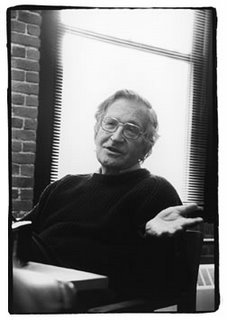
The DR-CAFTA has been criticised as sustaining colonial tensions. Noam Chomsky (pictured at right) has said that the agreement will maintain Central America as a region under US control.
Chomsky was in Santo Domingo in March this year giving several talks and public lectures. During this time he spoke in a free public lecture on "Latin American and US Foreign Policy" to a huge audience at the Foundation for Democracy and Development. In June this year, at a press conference in New York, Chomsky described "For the first time in its history, first time since the Spanish colonization, Latin America is moving towards a degree of independence and also a degree of integration ... And the United States is terrified."